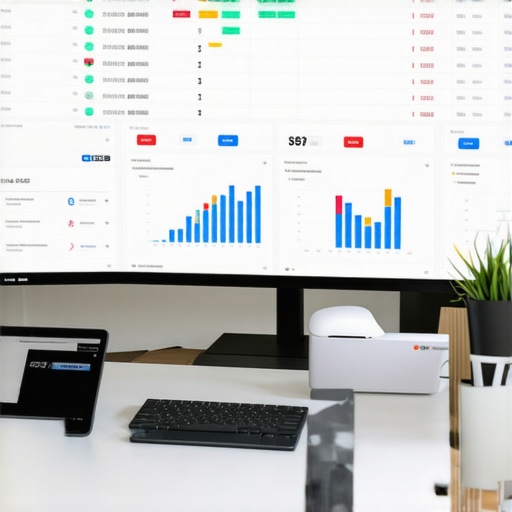
How to Stop Guessing and Start Measuring Real World Local SEO Results
For years, the local SEO industry has been obsessed with a single image: a grid of green circles showing a #1 ranking across a city map. But as we move into 2026, I have to be blunt with you – those green circles are often lying to you. I’ve seen countless business owners celebrate “dominating” their local area on a rank tracker, only to sit in a silent office wondering why their phones aren’t ringing. This is the “Vanity Metric Trap,” and it’s the primary reason why local marketing budgets are wasted.
The “Logic Gap” in local SEO is the chasm between visibility and actual revenue. In the current landscape, google business profile seo is no longer just about citations and keyword stuffing; it is about real-world interaction. Google’s algorithm has evolved to prioritize user behavior and physical proof over static data. If you want to scale your business, you must stop chasing ghost metrics and start measuring the signals that actually move the needle. As a Local SEO & GMB Expert, my philosophy is simple: I help businesses turn visibility into real phone calls and paying customers, not just map pins.
The Vanity Metric Trap: Why Rankings Aren’t Revenue
If you are looking at a report that only shows your keyword positions, you are looking at half the story. A #1 ranking can result in zero leads if the listing lacks “Viability.” You might be visible, but are you viable? In 2026, visibility is a commodity, but conversion is the currency. The reason a top-ranked listing fails often boils down to poor intent matching or a lack of trust signals that Google now weighs more heavily than ever.
Many business owners fall into the trap of thinking that more traffic equals more money. However, if that traffic is coming from users who are “just browsing” or are outside your actual service capability, those clicks are worthless. You need to How to Spot the Logic Gap in a Google Maps Algorithm Shift to understand why your rankings might be climbing while your ROI remains stagnant. This often happens when the algorithm shifts to favor “Interaction Depth” over simple proximity.
Furthermore, the rise of “Zero-Click Searches” means that users are getting their answers directly on the search results page. If your google business profile seo strategy doesn’t optimize for the immediate “Click-to-Call” or “Get Directions” action, the user will find what they need from a competitor who does. Rankings are a means to an end, not the end itself. We must differentiate between “being seen” and “being chosen.”
The 2026 Measurement Framework: Beyond Proximity, Relevance, and Prominence
The classic pillars of local SEO – proximity, relevance, and prominence – are still the foundation, but the 2026 algorithm has added a sophisticated layer: Interaction Depth. Google is no longer just looking at where your business is located; it is looking at how people interact with your physical space and your digital profile in real-time. This is where many local seo tools fall short – they track positions, but they don’t track the “Physical Proof” that Google now craves.
Google now utilizes a massive array of sensor data – including GPS pings, Wi-Fi network handoffs, and even Mixed Reality fixes – to validate that a business is actually serving customers. If your profile claims you are a bustling law firm, but Google’s anonymized data shows zero foot traffic or mobile device dwell time at your coordinates, your rankings will eventually tank. This is why Why 2026 Local Pack Optimization Requires Physical Proof has become a core component of my strategy for clients.
To rank google business profile listings effectively in this environment, you must optimize for these local seo ranking factors:
- Interaction Depth: How many layers of your profile does a user click through? Do they look at photos, read the Q&A, and then check your updates?
- Dwell Time: Both digital (on your profile) and physical (at your location).
- Velocity of Engagement: How quickly do users engage with your listing after it appears in their search results?
The google map pack ranking factors have shifted from “Who has the most citations?” to “Who provides the most reliable real-world solution?” Understanding proximity relevance prominence in this new light is the only way to maintain long-term dominance.
Tracking the “Money Metrics”: What to Actually Measure
To stop guessing, you need to transition your reporting to “Money Metrics.” These are the Key Performance Indicators (KPIs) that correlate directly with bank deposits. When you use a high-quality google maps rank tracker, you should be overlaying that data with interaction signals.
1. Click-to-Call Signals
This is the ultimate lead indicator. A user who clicks the call button has a high intent to purchase. However, simply tracking the click isn’t enough. You need to measure the duration of these calls and the time of day they occur. If you are getting clicks but no conversations, you have a “Leaky Bucket” in your intake process. I often find that the specific click-to-call signal that fixes a flatlined map pack performance is actually related to the responsiveness of the business during peak search hours.
2. Direction Requests
In 2026, a direction request is a powerful “Physical Proof” signal. It tells Google that a user intends to bridge the gap between the digital and physical worlds. High direction request volume is a leading indicator of increased local seo ROI. If your direction requests are low despite high rankings, your “Relevance” might be misaligned with the user’s actual needs.
3. Interaction Timing
How fast do users engage with your profile? If a user spends 30 seconds scrolling through your photos before clicking “Website,” that is a high-value interaction. It signals to Google that your content is engaging. If they bounce back to the search results immediately, it’s a negative signal. This is why improve google maps ranking efforts must include high-quality, high-resolution visual assets and frequently updated “Google Posts.”
4. Booking Conversions
If your industry allows for direct booking through Google (e.g., restaurants, salons, plumbers), this is your most accurate ROI metric. Direct integration with your CRM allows you to see exactly how much revenue a specific google maps ranking service is generating. This eliminates the guesswork entirely.
Auditing Your Lead Flow: Identifying the “Interaction Gaps”
A google business profile audit tool can tell you if your NAP (Name, Address, Phone Number) is consistent, but a real local seo audit must go deeper. You need to identify where users are dropping off in the conversion funnel. Are they finding you, looking at your reviews, and then leaving? That’s a trust gap. Are they finding you but not clicking at all? That’s a relevance gap.
While citations are the “entry fee” for local SEO, interaction signals are the “winning play.” You should How to audit your local citation sources without wasting a weekend, but don’t stop there. Look at your “Insights” tab in the Google Business Profile dashboard and compare “Discovery” searches vs. “Branded” searches. If your discovery searches are high but your actions are low, your profile is failing to convert the “cold” traffic that Google is sending you.
To measure local seo results effectively, you must perform a google maps audit that looks at your profile through the eyes of a customer. Is your “Primary Category” correct? Are your “Attributes” (like ‘Wheelchair accessible’ or ‘Free Wi-Fi’) filled out? These small details are what Google uses to match specific user intent with your business, directly impacting your google maps lead generation.
The Role of Real-Time Data in 2026 Rankings
We are entering an era where static profiles are becoming obsolete. The google maps seo 2026 landscape is defined by real-time data. Google is increasingly integrating live inventory sync and AR-ready shop signals into the Map Pack. If a user searches for a “red copper pipe” and your profile can prove you have it in stock right now via a live feed, you will outrank a competitor who has been there for 20 years but offers no real-time data.
This shift is why Why 2026 Local Pack Optimization Requires Real-Time Stock Data is a recurring theme in modern local strategy. Businesses that provide this data see significantly higher increase google business profile visibility because they are solving the user’s problem with 100% certainty. Google wants to be an “Answer Engine,” not just a “Search Engine.” Providing real-time proof that you have the solution is the fastest way to the top of the Map Pack.
Furthermore, local seo trends 2026 suggest that Google will continue to use “Point of Interest” (POI) data to verify business legitimacy. This means your digital presence must be mirrored by a physical reality that Google’s sensors can detect. The “ghost office” or “virtual mailbox” era is officially over; if Google can’t “see” your business via mobile device density, you won’t rank for competitive terms.
Conclusion: Turning Visibility into Paying Customers
The transition from “tracking” to “measuring” is the hallmark of a sophisticated business owner. It is easy to get caught up in the dopamine hit of seeing your name at the top of a search result, but unless that ranking is tied to a specific action – a phone call, a direction request, or a booking – it is a vanity project. My approach at Local Map Pack Ranking Pro is built on the belief that SEO should be a profit center, not an expense.
To truly measure local seo results, you must look at the entire lifecycle of the local customer. From the moment they trigger a search to the moment they walk through your door, every interaction is a data point that can be optimized. Stop chasing the “green arrows” of 2015 and start focusing on the interaction signals of 2026. If your current strategy isn’t driving measurable phone calls and foot traffic, it’s time to bridge the Logic Gap.
Don’t let your business get buried under the “Search Elsewhere” filter or lost in a sea of inactive pins. Focus on physical proof, interaction depth, and real-time data. When you align your digital profile with the real-world value you provide, the rankings – and the revenue – will follow naturally. It is time to stop guessing and start growing.