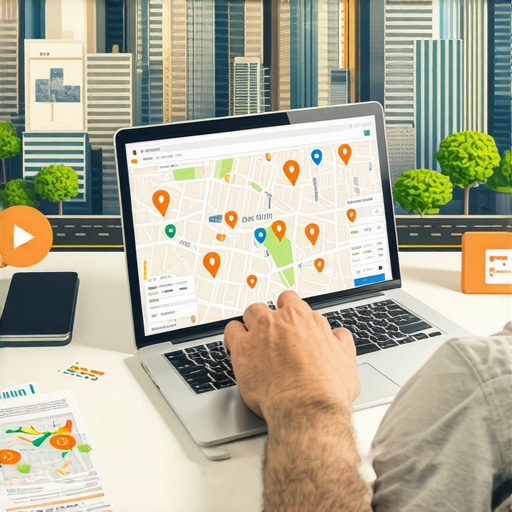
How to Fix a Maps SEO Campaign That Has Completely Stalled Out
There is nothing more frustrating in the world of digital marketing than a “flatlined” campaign. You’ve optimized the description, you’ve uploaded high-resolution photos, and you’ve built your citations. Yet, your rankings haven’t moved an inch in months. You are “doing everything right” according to the 2022 playbook, but your lead flow is drying up. As we navigate the complexities of the 2026 search landscape, it’s clear that the old ways of managing a google business profile seo strategy are no longer sufficient.
Local businesses lose leads every day because of poor SEO – not necessarily because they aren’t trying, but because they are stuck in a cycle of static optimization. I am Hussnain Local SEO, and I specialize in fixing systems that lose leads. My approach is results-driven, technical, and designed to bypass the common “proximity ceilings” that keep businesses trapped on page two. In this deep dive, I will provide the results-driven system you need to revitalize a stalled campaign and dominate the local map pack once again.
Section 1: The Diagnosis – Is it a Stall or a Penalty?
Before you can fix a problem, you must accurately identify it. Many business owners mistake a “proximity ceiling” – where Google simply refuses to show your business outside of a 2-mile radius – for a technical penalty. However, the landscape shifted significantly following the March 2026 Spam and Core updates. These updates were designed to prioritize “demonstrated local authority” over simple keyword density.
According to the recent “Google Webmaster Report,” there has been a significant shift in how the algorithm treats unconfirmed ranking fluctuations. If your rankings dropped overnight and haven’t recovered, you might be dealing with an algorithmic filter. If they have slowly drifted downward or stayed stagnant despite your best efforts, you are likely facing a “relevance stall.” This happens when your competitors are generating more real-time interaction signals than you are. To understand the nuances of these shifts, you should read my guide on How to Diagnose a Sudden Mappack Ranking Pro Drop Without Panicking.
When diagnosing a stall, look at your “Search Insights” in the Google Business Profile dashboard. Are your impressions steady but your clicks declining? That suggests a conversion/trust issue. Are both flat? That’s a visibility issue often tied to the 2026 core update’s focus on entity verification. To get a clearer picture of your standing, utilizing professional google business profile seo tools is the first step toward recovery.
Section 2: Fixing the “Technical Ghosting”
Sometimes, the reason your campaign has stalled isn’t about your content at all – it’s a technical glitch. A prominent issue reported extensively in Google Support forums recently is the “infinite loading bug” during location updates. This bug prevents changes to your service areas or hours from actually propagating through the system, leaving your profile in a state of “technical ghosting” where Google’s index doesn’t match your dashboard.
Beyond bugs, the most common technical killer is NAP (Name, Address, Phone) inconsistency. While some “gurus” claim citations are dead, the reality is that small discrepancies quietly kill lead flow. If your business is listed as “Main St. Ste 100” in one place and “Main Street, Suite 100” in another, Google’s confidence in your entity’s location diminishes. This lack of confidence results in a tighter proximity filter, meaning you only show up for people standing right outside your door.
Audit your citations immediately. Ensure every mention of your brand across the web is identical to your GBP. For a deeper look at how these minor errors manifest into major revenue losses, see my analysis on How Small NAP Discrepancies Are Quietly Killing Your Lead Flow. If you suspect your profile is suffering from technical lag, leveraging google maps seo tools can help identify hidden errors that the standard dashboard misses.
Section 3: Interaction Signals – The 2026 Ranking Engine
In 2026, SEO basics are not enough. The industry consensus, echoed by top experts on YouTube and at major search conferences, is that Google has moved toward a “Real-Time Interaction” model. Google no longer just looks at what you *say* you do; it looks at how users *interact* with your business in real-time. These “Interaction Signals” are now the primary drivers of the map pack.
What are these signals? They include click-to-call rates, driving direction requests, and specifically, the way users interact with the new “Ask Maps” AI feature. When a user asks, “Which plumber near me has the fastest emergency response time?” Google’s AI scans your reviews, your “Local Justifications” (those little snippets that say “Provides emergency service”), and your Google Posts to find the answer. If your profile is static, you won’t be the answer the AI provides.
To fix a stalled campaign, you must stimulate these signals. Encourage customers to not just leave a star rating, but to mention specific services and upload photos. These elements feed the “Local Justifications” that impact visibility. There is one specific interaction signal that most local SEO audits completely ignore, and it involves the “dwell time” a user spends looking at your profile photos and updates. You can learn more about this in my article: The Specific Interaction Signal Most Local SEO Audits Completely Ignore. To stay ahead of these AI-driven shifts, you need to improve google maps rankings by focusing on user engagement rather than just keyword stuffing.
Section 4: Advanced Entity & Category Optimization
If your rankings are stuck, you might be fighting a losing battle against “Big Box” competitors with massive budgets. To beat them, you need to utilize “3 Subtle Entity Edits.” The most critical of these is the strategic balance between primary and secondary categories. Many businesses set their categories once and never touch them. However, Google frequently updates the weight of specific categories. If you are a “Personal Injury Attorney,” but the current trend in your city favors “Law Firm” as a primary category, you will stall.
Another controversial but discussed strategy found on Reddit’s /r/localseo is the “24/7 hours” tactic. The idea is that by marking your business as open 24 hours, you capture late-night search volume. As an expert, I must provide an authoritative warning: while this can provide a temporary spike, it is a high-risk strategy. If Google’s AI detects (via mobile location data) that no one is actually visiting your business during those hours, or if customers call and get no answer, your trust score will plummet. It is better to align your “open hours” with your “actual service hours” to maintain long-term trust.
Refining your entity involves more than just categories; it involves your “Service Menu” and “Products.” These should be meticulously filled out with unique descriptions. For a step-by-step guide on the edits I use for my clients, read The 3 Subtle Entity Edits an SEO Expert Local Uses to Beat Big Box Competitors. For those looking for data-backed category insights, I recommend google business profile optimization software to see which categories are currently dominating your specific market.
Section 5: The Hyperlocal Backlink Strategy
Generic guest posts are the “junk food” of SEO – they might make your metrics look better, but they don’t provide any real nutritional value to your local rankings. If your campaign has stalled, it’s likely because your backlink profile lacks “Geographic Relevance.” Google’s 2026 algorithm is incredibly adept at distinguishing between a link from a generic blog and a link from a neighborhood-specific authority.
The solution is Hyperlocal Backlinking. This involves getting mentions from local news outlets, neighborhood association blogs, and local event pages. A single link from a local “Chamber of Commerce” or a “Best of [City]” list is worth a hundred generic guest posts. These links verify your “Entity” in a specific location, which is the key to breaking through the proximity filter. I’ve detailed why this works in my post Why Local News Mentions Beat Generic Guest Posts for Map Rankings. To track how these local links are impacting your authority, you should use local seo ranking tools that offer localized link tracking.
Section 6: Troubleshooting Specific Niches
Every industry has its own unique “stall points.” Here are some rapid-fire fixes for common niches:
- Pest Control: If your leads are ghosting, check your “Service Areas.” Over-extending your service area to cover the whole state often dilutes your relevance in your home city. See The Specific Reason Your Pest Control Leads Are Ghosting Your Profile for more.
- Med Spas: If you have high impressions but low consultations, your “Book Now” button might be broken or leading to a non-mobile-friendly page. Google tracks these failed interactions.
- HVAC: If you are missing emergency calls, ensure your “Emergency Service” justification is active. This is often triggered by specific keywords in your Google Posts and recent reviews.
Conclusion & CTA
Fixing a stalled Maps SEO campaign requires a fundamental shift in mindset. You must move from “volume” (more citations, more keywords) to “trust and interaction.” In the 2026 search environment, Google rewards the businesses that are most active, most responsive, and most integrated into their local community. By auditing your technical foundation, stimulating real-time interaction signals, and refining your hyperlocal authority, you can break through any plateau.
Don’t let your business stay invisible. Whether you choose to use a professional local seo performance software to audit your own profile or decide to hire a professional google maps ranking service to bypass proximity filters for you, the time to act is now. A stalled campaign is a leaking bucket of revenue – plug the holes today.